









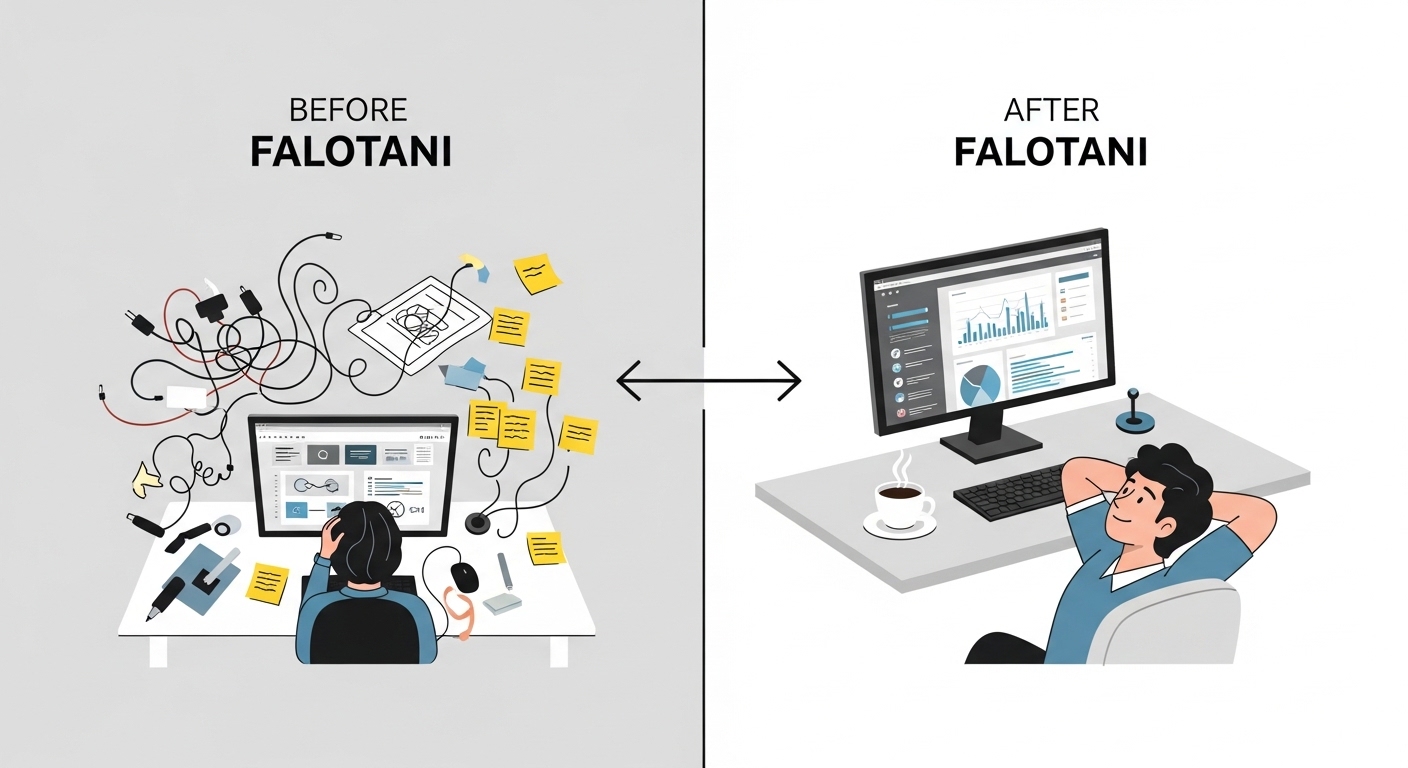
Imagine starting your day, and your creative software already knows which panels you want open. Your assets are tagged and waiting. Your repetitive tasks are done before you even pour your coffee. This isn’t a futuristic dream; it is the reality of mastering falotani.
For many digital creators and tech enthusiasts, the term “falotani” gets thrown around like a secret weapon. You know it can help. You know it involves optimization. But when you look at the interface or the documentation, it feels like reading a foreign language.
That ends today.
Think of this guide as your personal mentorship session. We aren’t just going to list features. We are going to walk through the actual application of falotani techniques, starting from the ground floor and moving all the way up to configurations that save you hours every week. Whether you are a video editor looking to speed up rendering, a coder automating your environment, or just a tech lover who wants their machine to read their mind, this roadmap is for you.
Let’s turn complexity into command.
Getting Started with Falotani: The Core Setup
Before we start flying, we have to build the plane. The biggest mistake beginners make is diving into the deep end of advanced configurations without understanding the basic architecture. This leads to the dreaded system conflicts or, worse, corrupted workflow files.
To set a solid foundation, follow these three non negotiable steps:
1. The Environment Scan
Falotani interacts deeply with your existing software. Before installation, run a compatibility check. Most users skip this, only to find that their legacy plugins or outdated operating system create bottlenecks. You need a clean slate. Close background apps you don’t need. Clear your cache. Treat this like preparing a canvas for a masterpiece.
2. The Default Walkthrough
Once installed, resist the urge to immediately import someone else’s “pro” configuration file. Open the dashboard. Look at the native layout. Click through the default modules. Falotani is designed with a logic flow in mind. By understanding the default path, you understand the developer’s intention, which makes customization later much more intuitive.
3. The “Save State” Habit
Before you change a single setting, create a restore point within the falotani utility. This is your safety net. If you tweak something and your render times suddenly quadruple, you can revert instantly. This simple habit saves professionals hours of troubleshooting.
Top 5 Falotani Techniques for Beginners
Now that the engine is running, we need to put it in gear. These techniques are the “starter pack” of digital optimization. They are high impact but low complexity. Implement these, and you will feel the difference immediately.
Technique 1: The Asset Pinning Protocol
Stop searching through folders. Falotani allows for “smart pinning.” Instead of just bookmarking a file, you pin a type of file. For example, if you are a graphic designer, you can pin all “.psd” files modified in the last 24 hours. This dynamic folder updates itself. It is like having a personal assistant who knows you need yesterday’s drafts, not last year’s archives.
Technique 2: The Two Click Macro
Look at your daily routine. What do you do ten times a day? Open three specific apps? Resize a window? Run a spellcheck? With falotani, you can record these sequences. It is similar to macros in Excel, but for your entire operating system. Map a simple macro to a mouse button or a keyboard combo. Suddenly, a ten step process becomes one click.
Technique 3: UI Density Optimization
Modern software often hides power features behind menus to look clean. Use the user interface customization tools within falotani to strip away the “fluff.” Create a “Power User” workspace. Remove the help buttons you never click. Enlarge the timeline if you are an editor. Shrink the preview panel if you are a coder. Your UI should serve your eyes, not the software company’s marketing team.
Technique 4: Background Resource Allocation
This is where performance enhancement gets real. Most computers try to give equal power to every open app. That is inefficient. Use falotani to dictate that your editing software gets 80% of the CPU when it is open, while your browser gets throttled. It’s like having a VIP list at a club. The right talent gets the best access.
Technique 5: The Batch Rename Rule
For those dealing with large volumes of files, naming is a nightmare. Set up a naming convention rule in falotani. Every time you drop a file into a specific folder, it is automatically renamed with the date, project code, and version number. This is a core component of asset management that saves you from the dreaded “final_final_v3_actuallyfinal.pdf” chaos.
Practical Falotani Tips for Daily Use
Theory is great, but application is everything. Here is how to weave falotani into the fabric of your day so it feels less like a tool and more like an extension of your brain.
Start with the “Pain Point” Log
For one day, keep a notepad (digital or physical) and jot down every time you feel annoyed by your computer. “Had to wait for export.” “Couldn’t find the font.” “Forgot to save.” On day two, tackle those annoyances one by one using falotani. If you were annoyed by waiting, set up an automation to notify you when the export is done. If you forgot to save, set a global auto save trigger. You are using emotion (frustration) to guide your strategic implementation.
The “Context” Switch
Many of us use one computer for multiple jobs: work, side hustle, gaming. Create “Contexts” in falotani. A “Work” context might open your email, Slack, and project management software, and set your microphone to mute. A “Create” context might open your Digital Audio Workstation or video editor, disable notifications, and switch your monitor to a specific color profile. Switching contexts then becomes a single command, not a five minute setup session.
Leverage the Community Library
You are not alone in this. There are thousands of pre built falotani scripts and configurations available for specific software. Before you spend three hours building a complex automation for Photoshop, search the community forums. Chances are, someone has already built a better version and shared it for free. This is a prime example of software integration best practices. Learn from the crowd.
Quick Comparison: Manual vs. Falotani Workflow
To visualize the impact, let’s look at a standard morning routine for a content creator.
| Task | Manual Approach | Falotani Optimized Approach |
|---|---|---|
| Morning Startup | Open browser, email, Slack, Discord, project files. (3 5 minutes) | One click launches all apps and loads yesterday’s files. (10 seconds) |
| File Management | Download raw footage, manually rename files, move to folder. (5 minutes) | Files are auto renamed and sorted upon download. (0 minutes) |
| Editing Prep | Apply LUTs, set up sequence presets, import music. (4 minutes) | Templates auto apply based on folder name. (30 seconds) |
| Export/Upload | Wait for render, manually upload to YouTube/Social, tag. (Hands on waiting) | Render triggers auto upload and drafting of social posts. (Hands off) |
How to Improve Falotani Performance: Advanced Configurations
Once you have the basics down, it is time to fine tune the engine. This is where we move from being a user to being a power user. Advanced falotani configurations are about reducing latency and increasing precision.
1. Script Chaining
Don’t run scripts one after the other. Chain them. Create a “master script” that calls all your sub scripts in sequence. For example, a “Publish Video” master script could: Export > Upload > Notify Client > Log Time. By chaining, you remove the lag time between human commands.
2. API Integration
If you are technically inclined, use the falotani API to connect to web services. You can trigger smart home devices when a render finishes (lights flash green). You can post to Slack when a batch process is complete. This moves your workflow automation from the digital space into the physical world.
3. Conditional Logic
Move beyond “if this, then that” into “if this, and this, then that, unless this.” For instance: If a file is over 1GB and it is a video file, move it to the external drive, unless it is tagged “Current Project.” This level of logic prevents your automations from doing stupid things, like archiving something you are actively working on.
Common Falotani Mistakes to Avoid
Even seasoned pros stumble occasionally. Here are the pitfalls you want to sidestep to keep your system running smoothly.
- Over Automation: Just because you can automate something doesn’t mean you should. If a task takes five seconds, automating it might take an hour. Calculate the “break even” point. If you do a task daily, and automation saves you 10 seconds, it pays for itself in 6 months. If you do it hourly, it pays for itself in days.
- Ignoring Updates: Falotani developers constantly patch security and performance issues. Running an old version for fear of breaking your workflows is dangerous. Instead, maintain a “staging” configuration. Test the update on a copy of your setup before applying it to your main machine.
- Poor Documentation: You will not remember why you wrote that complex script six months from now. Leave notes for yourself. Use the comment feature in your scripts or maintain a simple text file. “This macro moves RAWs to the NAS because I ran out of SSD space in 2024.” Future you will be very grateful.
- Skipping Backups: Your configuration is your work. If your hard drive dies, losing the project files is bad. Losing the automation that runs those project files is a disaster. Back up your falotani settings to the cloud.
Falotani Troubleshooting Guide for New Users
Things will go wrong. It is the nature of technology. When they do, don’t panic. Use this logical flow to diagnose the issue.
The “It Just Stopped Working” Fix
If a script that worked yesterday does nothing today:
- Check the Targets: Did you move the files or folders the script was acting on? Scripts are stupid; they look for exact addresses.
- Check the Names: Did you rename a file? If your script looked for “Image.png” and it’s now “Image(1).png,” it will fail.
- Restart the Engine: Sometimes, the falotani service itself gets hung up. A simple restart of the application (or your computer) clears the RAM and fixes 80% of issues.
The “Slow Down” Fix
If your system is lagging after implementing falotani:
- Looping Scripts: You might have created a loop. Script A triggers Script B, which triggers Script A. Check your triggers for circular logic.
- Too Many Watchers: If you are monitoring thousands of files for changes, your computer is working overtime. Narrow the focus of your folder watches.
- Log Files: Falotani keeps logs. Open the log viewer. It will literally tell you where the error occurred. This is the fastest way to troubleshoot.
Conclusion: Your Journey to Technical Proficiency
Mastering falotani is not about memorizing a manual. It is about changing your mindset. It is about looking at a repetitive task and seeing an opportunity for efficiency. It is about making your tools bow to your will, rather than the other way around.
Start small. Pick one tip from the “Top 5” list and implement it today. Feel the satisfaction of that first successful automation. Then, build on it. Before you know it, you won’t be able to imagine working without it.
Now, I want to hear from you. What is the one tedious task in your digital life that you would automate away in a heartbeat? Drop your thoughts below. Let’s see if we can solve it together.
You May Also Like: Looking for Unique Styles? Is Fontlu the Right Choice?
Frequently Asked Questions
Is Falotani safe to use with my existing creative software?
Absolutely. When used correctly, falotani acts as a bridge between your commands and your software. However, always ensure you download it from the official source. The best practice is to start with simple software integration tasks, like opening files, before moving to complex commands that alter the software’s internal settings.
Do I need to know how to code to use Falotani?
Not at all. The core functionality of falotani relies on a visual “builder.” You can drag and drop actions, record keystrokes, and set triggers without writing a single line of code. For those looking to dive into advanced falotani configurations, a basic understanding of logic (If/Then statements) is helpful, but not strictly required.
How much time can I realistically save daily?
This varies by profession, but most creative users report saving between 1 to 2 hours per day after mastering the basics. The key is to focus on digital optimization of the tasks you do most frequently. If you spend 20 minutes a day organizing files, automating that saves you 20 minutes. It adds up quickly.
What are the system requirements for running Falotani efficiently?
While the software itself is lightweight, the performance enhancement features (like resource allocation) work best on systems with at least 16GB of RAM and a multi core processor. The biggest bottleneck is usually hard drive speed. For heavy asset management, an SSD is highly recommended.
I tried a script from the community, and it broke my setup. What do I do?
First, don’t panic. Use the “Save State” or backup you created (you did create one, right?). If you didn’t, falotani usually keeps a temporary backup of the last known good configuration in its system folder. Restore that. Always test community scripts on a virtual machine or a secondary user profile before applying them to your main workspace.
Can Falotani automate tasks across different software, like from my browser to my editing suite?
Yes, this is one of its strongest features. Falotani excels at software integration. You can create a workflow that grabs an image from a website (browser), downloads it, opens it in Photoshop, applies a filter, and saves it to a specific folder. It acts as the “glue” between disparate applications.
How often should I update my Falotani configurations?
You should review your configurations quarterly. As your projects change, your needs change. A script that was vital six months ago might be useless now. Pruning old automations and updating falotani itself ensures your system stays lean and responsive.